
Chen T’ang Gao 陳唐高
John Chen and the T'ang Quartet
Skip to Photos
Skip to Artist Bios
Collaborative Programme
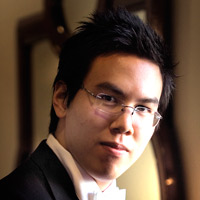
Chen T’ang Gao (陳唐高) is a festival programme of Piano Quintets featuring Sydney International Piano Competition winner John Chen (New Zealand) and Singapore's foremost string ensemble, the T’ang Quartet, who together present a substantial new work by internationally respected Chinese-born New Zealand composer Gao Ping. The Asian-themed ensemble was assembled for the 2009 Christchurch Arts Festival, where the Gao Ping commission received its world-premiere. A repeat is scheduled in Macau on 31 October. The programme:
- Schnittke Piano Quintet (or: Shostakovich Quintet)
- Gao Ping Piano Quintet (premiered 3 August 2009)
- Dvorak Piano Quintet
Critical Acclaim: Commitment and control with work of great depth
"Gao Ping's Piano Quintet Mei, Lan, Zhu, Ju held its own in the company of quintets by Schnittke and Dvorak.
"The playing throughout was of the highest standard and whether tackling angular jumps or fluid romantic lines, the players displayed absolute commitment and control.
"Communication within the ensemble was fastidious and the balance finely judged. At the heart of the ensemble was John Chen, readily acknowledged now as one of the finest exponents of his generation and again showing that his playing in a chamber setting is every bit as impressive as his concerto performances.
"Gao's four-movement quintet took, as its inspiration, four plants important in Chinese culture, and what the composer wrought from that initial source was a work of well-disciplined unity whose canonic fragments gradually coalesced into broader ideas. Gao created some extraordinarily delicate, sometimes raw textures, and by the time the melodious viola solo of the third movement allowed us to catch our breath I felt we were hearing a work of tremendous depth.
"Needless to say, new works need commitment from the players and boy, did this get it, the players bringing out the Chinese-influenced sounds brilliantly as well as the familiar Western ones.
"By contrast, the opening Schnittke was every bit as dark and brooding as this intense work demands. Again Chen was at the heart, with the tolling of the repeated notes achieving an almost impossible softness. The descent into the nightmarish pastiche that is Schnittke's trademark was well done."
Patrick Shepherd, Christchurch Press, August 4, 2009 Full Review
"Combined with the touches of Chinese folkloric influence in his decorative passages, especially the piano part, it all adds up to a music bathed in timeless clarity and the beauty of Zen philosophy, and it charmed the audience instantly."
Ian Dando, The Listener, August 22-28 2009 Full Review
Sydney International Piano Competition Winner John Chen:
"…brings to mind those few really creative interpreter-pianists like Richter and Serkin"
Clive O'Connell, The [Melbourne] Age
"…a remarkable pianist, and a musician wise beyond his years..."
John Button, The Dominion Post
Singapore’s foremost String Ensemble, the T’ang Quartet:
“flashes of inspired synchronicity that fired the senses into overdrive, even euphoria.”
The Scotsman (Edinburgh International Festival ’07)
“…pushed the musical envelope in a variety of refreshing ways…”
Business Times (Singapore International Festival ’07)
Internationally-recognized Chinese New Zealand composer Gao Ping:
Gao Ping is a "total musician…and a composer whose effortless fluency I envy deeply."
New Zealand “Dean” of composers Jack Body
Photos
Credit: Photo by Jane Ussher
Credit: Unrestricted
Credit: Photo by James Penlidis
Artist Bios
T'ang Quartet Bios
The T'ANG QUARTET, formed in 1992, started their professional career in 1999 with unanimity of purpose: to break new ground by extending the sheer fun and enjoyment of classical music to a larger audience, as well as setting new standards of artistic achievement. Trained individually in London and Moscow, the T'ANG QUARTET was awarded a fellowship in 1997 to work in the USA with celebrated artists Paul and Martha Katz of the Cleveland Quartet; Norman Fischer, Kenneth Goldsmith and Sergui Luca at the Shepherd School of Music, Rice University, Houston.
Presently, T'ANG QUARTET's repertoire includes works by the classical masters and contemporary composers such as Bright Sheng, Peter Sculthorp and Chen Yi. The Quartet's hip and upbeat stage personality together with their collaboration with celebrated artists such as pianists, Horia Mihail and Tedd Joselson and cellists Carter Enyeart and Paul Katz, have captivated audiences in the USA, Europe, Australia, China and Southeast Asia.
The Quartet's performances have garnered many international awards. They were prizewinners of the 2nd Internationaler Joseph Joachim Kammermusikwettbewerb in Weimar, Germany in 1999, receiving additionally the Special Jury Prize for best interpretation of a contemporary composition. The same year saw the Quartet awarded a National Endowment for the Arts grant from the US Government to be a resident ensemble in a special programme of Chamber Music America. In 2000, the T'ANG QUARTET was also awarded the Bartok prize in Austria by the Prague-Vienna-Budapest Sommer Akademie and presented with the Cultural Award by the Japanese Chamber of Commerce and Industry.
The Quartet has since performed to critical acclaim internationally - from concerts at the Tanglewood Festival in USA and the Mexican Cervantino Music Festival to BBC Broadcasts; From London's Wigmore Hall to Australia's music festivals in Melbourne and Canberra, and in mid-2006 in Ireland's West Cork International Chamber Music Festival and at the Cheltenham Music Festival.
In June 2007, T'ANG Quartet premiered Optical Identity; a collaborative production with Theatre Cryptic (Scotland) was commissioned by the Singapore Arts Festival. The European premiere took take place at the Edinburgh International Festival in August, and the production then traveled to the Alicante International Contemporary Music Festival (Spain) in September, and tours Scotland in October and November 2007.
T'ANG Quartet was invited to perform Azerbaijan composer Franghiz Ali Zadeh's Mugam Sayagi at a UNESCO award Ceremony in Paris on 3 April 2008, where she was receiving the honorary title of UNESCO Artist for Peace.
Of the many accolades received, The Strad in UK praised the T'ANG QUARTET as 'a fine-toned, well- balanced, thoughtfully blended ensemble without a weak-link - and with an excellent sense of style'. And the Boston Globe described the Quartet as 'astounding'...for their 'confidence, bravura and charisma'. Critics at London's Evening Standard commented that "This ensemble is outstanding. Unanimity of attack is uncanny, and the intonation and internal balance both impress greatly. These are plainly minds which share a wavelength."
In Singapore, apart from recitals, the Quartet is also very active in music education and outreach programmes, performing at different venues from schools to discotheques, including a profile stint on MTV Asia. In June 2006, T'ANG QUARTET participated in Festival-onedotzero-singapore. In September 2006, it was accorded the prestigious honour of performing at the opening of Singapore Biennale, and to foreign dignitaries at the IMF and World Bank Annual Meetings held in Singapore. Following its highly acclaimed and successful debut CD in 2005, The Art of War, T'ANG QUARTET released its second CD, Made in America, in May 2006.
T'ANG Quartet has also recorded the soundtrack for Feet Unbound, a feature film retracing the Long March as undertaken by teenage girls, directed by Ng Khee Jin.
The T'ANG QUARTET was from 2001 ' 2005 on the faculty of Boston University's Tanglewood Institute. The Quartet is currently quartet-in-residence at Yong Siew Toh Conservatory of Music at the National University of Singapore.
Tang symbolizes the golden age of the arts in Asia - the Tang Dynasty.
Members of the quartet play instruments on generous loan from the Rin Collection and Mr. Jiri Heger.
Ng Yu-Ying, 1st Violin
Ng Yu-Ying embarked on his professional career as a violinist in the Singapore Symphony Orchestra after graduating with first-class honours from the Royal Academy of Music, UK, where he studied with Clarence Myerscough and Erich Gruenberg. He was awarded the Alex Templeton Prize, Roth Prize and Dominion Fellowship for his Graduation Recital.In 1997, Yu-Ying became a founding member of Singapore's first professional string quartet, which has performed to critical acclaim in America, Australia and Europe. Aside from chamber music performances, his collaborations with violist, Jiri Heger, have also brought him to the Czech Republic where he performed in concerts and in live telecasts on Czech television.Yu-Ying is now on the faculty of the Yong Siew Toh Conservatory of Music at National University of Singapore and was the Boston University University Tanglewood Institute from 2001 to 2005.
Ang Chek Meng, 2nd Violin
Winner of the Singapore National Music Competition in 1985 and 1987, Ang Chek-Meng went on to further his studies under a Singapore Symphony Orchestra Scholarship at the Royal Academy of Music in London. He studied under Jean Harvey, Erich Gruenberg, as well as members of the Amadeus Quartet. For his outstanding results, Chek-Meng was awarded the Countess of Munster Trust Scholarship and graduated with honours.Chek-Meng joined the Singapore Symphony Orchestra in 1991 and left 7 years later to pursue his love for chamber music by becoming a member of the award-winning T'ang Quartet. The Quartet were appointed the first Quartet-in-residence at the Sheperd School of Music, Rice University, USA. There Chek-Meng worked with world-renowned artists like Paul and Martha Katz of the Cleveland Quartet, Kenneth Goldsmith and Norman Fischer.As a member of the Quartet, Chek-Meng has performed to critical acclaim at major venues such as the Aspen Music Festival, Tanglewood Festival, Music Mountain Chamber Series, Melbourne Festival and New Zealand Arts Festival as well as in engagements around Asia.Chek-Meng is currently a faculty member at the Yong Siew Toh Conservatory of Music at the National University of Singapore. His previous appointment with the Boston University Tanglewood Institute was from 2001 to 2005.
Lionel Tan, Viola
Lionel Tan began viola studies under Jiri Heger and was awarded a scholarship to study at the Royal College of Music in London where he graduated in performance and pedagogy. He was bestowed the Lionel Tertis Prize for outstanding performance.Lionel started his professional career playing the viola in the Singapore Symphony Orchestra. Aside from extensive experience gained from 11 years as a violist in the Orchestra, he has also established himself as a prize-winning soloist and chamber musician which has taken him all over the world.Lionel also studied the viola with Martha Katz and Karen Ritscher in the USA, and with Margaret Major, Christopher Wellington and Milan Skampa in Europe. As a member of the award-winning and critically acclaimed T'ang Quartet, he was a pupil of Paul Katz, Norman Fischer and Kenneth Goldsmith at the Shepherd School of Music, Rice University, USA.Lionel is now appointed to the faculty at the Yong Siew Toh Conservatory of Music at National University of Singapore, and joined the faculty at the Boston University Tanglewood Institute from 2001 to 2005.
Leslie Tan, Cello
Leslie Tan, cellist of the internationally renowned T'ang Quartet has performed, both as a soloist and a chamber musician, to critical acclaim in major venues and festivals around the world. Some of these festivals include the Tanglewood and Aspen Festivals in the USA; the Melbourne and Port Fairy Festivals in Australia; the New Zealand Arts Festival; the Hong Kong Arts Festival; and the Prague-Vienna-Budapest Sommerakademie and Aarhuus Festival in Europe. He has also been broadcasted by the BBC in London.In 1980, after only 4 years of cello studies, Leslie was awarded a scholarship to further his studies in London where he graduated from both the Trinity College of Music and the Royal College of Music. Leslie went on to the Tchaikovsky-Moscow State Conservatory as a graduate-assistant of Natalia Shahkovskaya. In the USA, he was a pupil of Paul Katz and Norman Fischer.Leslie was a cellist in the Singapore Symphony Orchestra for 13 years. In a career that has spanned almost 20 years, from orchestral to chamber and solo performances, he is very much sought after as a pedagogue as well as a performer. Leslie is also in demand as a collaborative artiste with performers in other disciplines such as dance, theatre and even pop music.Leslie is now on the faculty of the Yong Siew Toh Conservatory of Music at the National University of Singapore and was with Boston University Tanglewood Institute from 2001 to 2005.
Concertmaster of the Melbourne Symphony Orchestra since 2003, Wilma Smith combines her love of the symphonic repertoire with a busy chamber music life both in her adopted home of Melbourne and in New Zealand, where she was raised. After leaving Fiji, her birthplace, as a small child, Wilma took all musical opportunities on offer in her new home of Auckland, New Zealand, culminating in study at Auckland University and early professional experience with the Auckland Symphonia (now Philharmonia) and New Zealand Symphony Orchestra. She then continued her studies in Boston at the New England Conservatory with the legendary Dorothy DeLay and Louis Krasner, playing in masterclasses for many others including Joseph Gingold, Yehudi Menuhin and Sandor Vegh. She was founding first violinist of the Lydian String Quartet, prizewinners at Evian, Banff and Portsmouth International Competitions and winners of the Naumburg Award for Chamber Music. Although the Lydian String Quartet was Wilma's professional focus in Boston, she also worked regularly in the Boston Symphony Orchestra and led the Harvard Chamber Orchestra, the Handel and Haydn Society and Banchetto Musicale, a period instrument baroque orchestra. An invitation to form the New Zealand String Quartet took her back to Wellington in 1987 and she was first violinist of the quartet until her appointment as Concertmaster of the New Zealand Symphony Orchestra in 1993. During her years with the quartet they toured New Zealand and Australia extensively and performed at the Tanglewood Festival. Prior to her departure for Melbourne, the NZSO honoured her with the title of Concertmaster Emeritus. Wilma has enjoyed a longstanding duo partnership with pianist, Michael Houstoun and since moving to Melbourne, has formed the Munro/Smith/Berlin Trio with Ian Munro (piano) and David Berlin (cello) with whom she has performed regularly in New Zealand and Australia. In the last two years Wilma has been a frequent guest with another Melbourne group. Ensemble Liaison, whose core is clarinet, cello and piano but who expand with other instruments to perform a widely varied and eclectic repertoire. The 2008 International Festival of the Arts in Wellington provided an opportunity for three concerts of stimulating chamber music collaboration with Steven Isserlis (cello), Melvyn Tan (piano), Michael Houstoun (piano) and Carolyn Henbest (viola). The connection with Mr Isserlis will continue in 2009 with Wilma's participation in his Open Chamber Music Seminar at Prussia Cove in Cornwall, England. While performing the symphonic and chamber music repertoire is undoubtedly the core of Wilma's musical life, she is also a committed teacher of violin at Melbourne University and privately. Wilma lives with her partner, Peter Watt, a computer consultant and reformed trombonist, their three daughters, Jessye, Rosie and Sophie, two dogs, two cats and ten fish at last count.
##
Stay Up to date
Sign up now to hear about important releases, performances, and events by Maxima artists.


